8 Best Chatbase Alternatives in 2026 (Free and Paid Options)
On this page

Tired of watching your Chatbase credits disappear halfway through the month? You're not the only one.
Chatbase is a legitimately clever tool for spinning up a quick FAQ chatbot, but its pricing model quietly punishes anyone who succeeds with it.
There is no shortage of Chatbase competitors that do the same thing for less, or do it better.
Let’s look at the top ones.
Why Chatbase (A Quick, Fair Review)
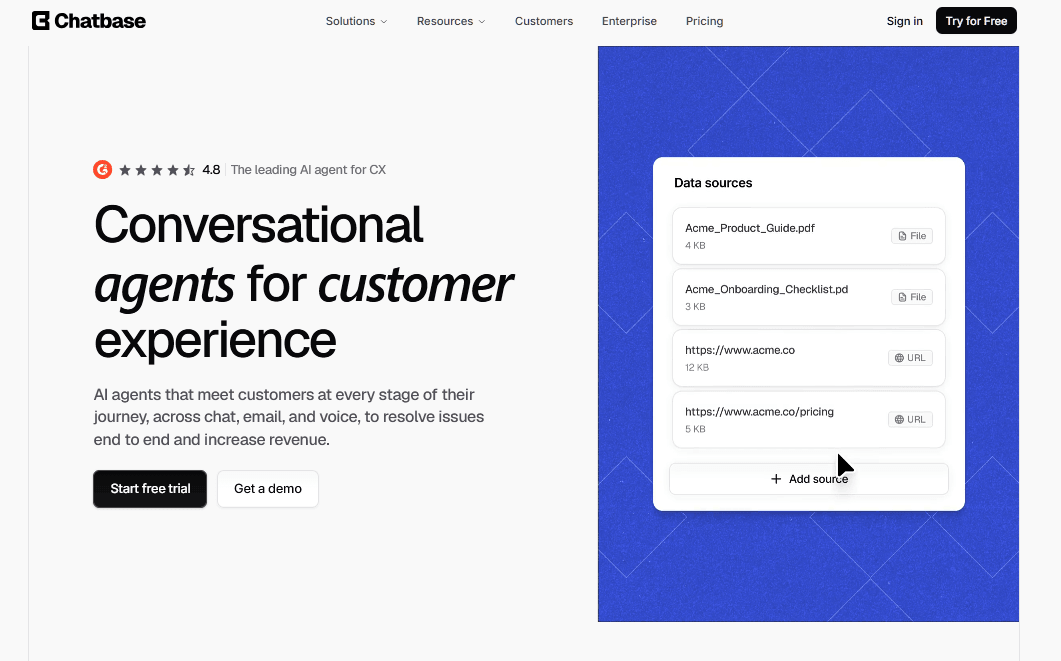
Before we look into Chatbase alternatives, let's be honest about what Chatbase does well. If you dismiss it as a bad product, you'll pick a replacement for the wrong reasons.
Chatbase launched in 2023 and rode the "ChatGPT for your website" wave early.
In Chatbase, you upload your documents, paste URLs, or crawl sitemap, and within minutes you have an AI agent that answers customer questions in your brand voice.
Since then it has grown into a fuller AI agent platform with "AI Actions" that can book meetings through Cal.com, update a CRM, or trigger API workflows.
What Chatbase does well:
- You can get a working bot live in under 10 minutes, which is very impressive.
- Model choice: You are not locked to one LLM. You can pick from GPT models, Claude, Llama, and DeepSeek depending on your needs.
- It handles 80-plus languages out of the box.
- Broad data ingestion: It trains on six data types including PDFs, DOC/DOCX, TXT, CSV, websites, and Q&A pairs.
- A feedback loop: You can review conversations, spot where the bot failed, and edit answers to improve accuracy over time.
Chatbase pricing in 2026 runs from a free plan up through Hobby, Standard, and higher tiers:
- The free plan includes around 50 message credits per month with one agent
- Paid plans start at about $40/month for Hobby
- Standard plans start at around $150/month
- Unlimited or Pro plans cost around $399 to $500/month
On paper, this looks reasonable.
So Chatbase is fast, flexible on models, and easy. If that were the whole story, you would not be here.
But that's not where the story ends.
Why Look for Chatbase Alternatives?
Complaints about Chatbase tend to cluster into a few consistent themes. Once you've read enough reviews, you can anticipate them.
And I also agree with most of them:
1. Pricing and message
Chatbase measures every reply in message credits, and one reply can consume 2 to 6 credits depending on which model you use. Credits do not roll over, and when they run out, your agent simply stops answering unless you have enabled auto-recharge at $40 per 1,000 message credits.
This can easily add hundreds in monthly overage fees. That unpredictability is the single most cited reason teams leave.
2. White-labeling is expensive
Removing the “Powered by Chatbase” badge is a paid add-on that costs $1188 per year.
For an agency building bots for clients, this is not optional and dramatically raises the total cost of ownership.
3. No pre-launch testing
You cannot simulate the agent against your historical tickets before going live, so it gets tuned on real customers.
4. Customization and workflow gaps
There is no conditional-logic builder or branched conversation flows. If you want different flows by user type, complex routing, approvals, or multi-step process handling, Chatbase is not built for it.
5. Support and billing reputation
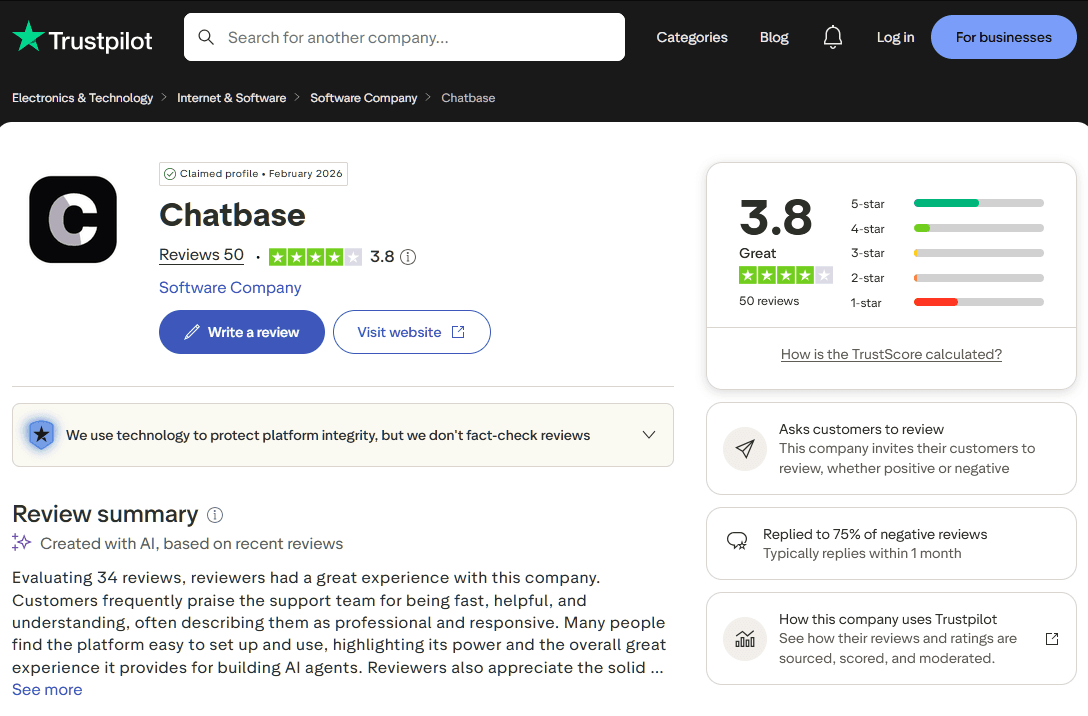
Trustpilot’s customer-service sub-score for Chatbase sits at 3.8 out of 5, with recurring complaints about billing and denied refund requests.
None of this makes Chatbase a scam. It makes it a tool with a specific sweet spot (fast, simple FAQ bots) and a specific failure mode (scaling, agencies, deep customization, budget predictability).
If you're hitting that failure mode, the rest of this guide will help.
The Best Chatbase Alternatives for 2026
Now, let's look at the best Chatbase alternatives and competitors, software that does the same job Chatbase does: building and managing AI-powered chatbots.
1. HelpJet
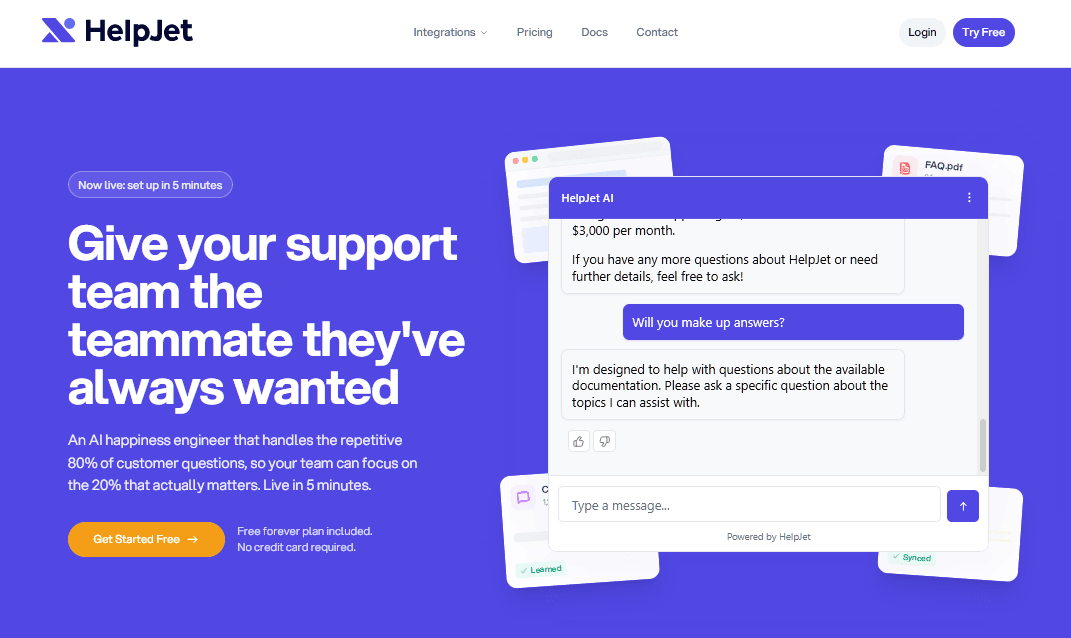
HelpJet is an AI support chatbot software. It launched in July 2026, and it's designed to take the content you already have (help docs, website pages, PDFs, private SOPs, past support conversations) and turn it into an answer engine that resolves the boring, repetitive questions that eat up your team's time.
Most chatbot platforms are like buying a commercial kitchen when you just want to make dinner. HelpJet, on the other hand, is a very good stove. For businesses looking to eliminate 80% of repetitive tickets and focus on running their business, this level of focus is essential.
What we like about it is how little it tries to do. There are no decision trees, no scripted branches, no prompt tuning screens.
You point it at your domain, it crawls your pages, posts, docs, and PDFs, and you're live.
Key Features and What Stood Out
- Genuine free forever plan (1 bot, 100 interactions per month), which lets you prove value before paying anything.
- Five-minute install through the WordPress plugin (a floating chat widget shows up as soon as it's activated) or a single line of code for any other site.
- Automatic weekly re-crawl so answers stay current without you thinking about it.
- Trains on private content too, including internal SOPs, help articles, PDFs, and past support conversations.
- Clean handoff to a form or email when the bot can't resolve something, with the bot learning from the human resolution.
- Multi-bot support on the Pro plan for multisite setups or brands running more than one storefront.
Limitations and What to Watch For
- It's new. HelpJet launched in mid-2026.
- It's not a full help desk. If you need a ticket queue, pair it with a shared inbox tool (HeroThemes' Heroic Inbox exists for exactly that job).
- If your use case needs conditional-logic flows or heavy scripted branches, this isn't the tool by design.
Pricing
HelpJet has a free forever plan with one bot and 100 monthly interactions, and a Pro plan at $29/month (or roughly $23/month billed annually) that includes 3 bots and 1,000 interactions per month, with a 14-day trial.
Verdict: What Sets It Apart
2. Botpress
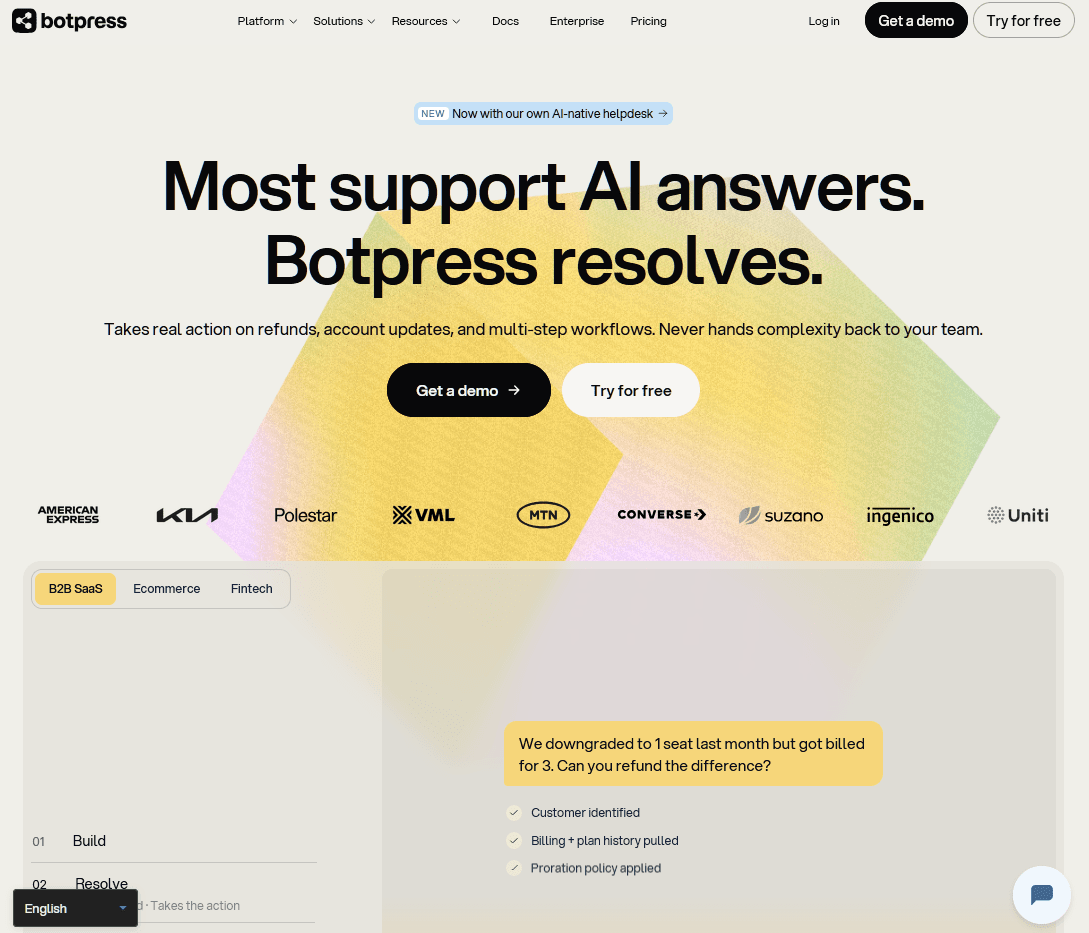
For developers wanting an open-source Chatbase alternative, Botpress is the one to beat.
Botpress started in 2017 in Quebec as one of the first open-source chatbot frameworks and has since rebuilt itself as an "LLM-native" platform. The language model is at the center of how the agent reasons, rather than being added to a rules engine.
Botpress occupies an interesting middle ground.
It's more powerful and extensible than a widget-style tool, but it still ships with a polished visual Studio that a non-developer can work in.
Under the hood, an Autonomous Engine (powered by a custom inference engine called LLMz) blends generative reasoning with deterministic, coded workflows. That combination is what keeps the agent adaptable without letting it go off the rails.
Botpress rewards teams that will actually use its flexibility, and quietly punishes those who just wanted a simple bot with a larger setup bill.
Key Features and What Stood Out
- Open-source with real self-hosting on V12 for teams that need data control.
- Multi-LLM support with routing and your own API keys.
- Autonomous Node that lets the LLM decide when and how to execute actions dynamically.
- Visual Studio plus code access, so a designer and a developer can collaborate on the same bot.
- Enterprise footing: SOC 2, GDPR compliance, and dedicated customer success on higher plans.
Limitations and What to Watch For
- "AI Spend" is billed on top of the base plan, and it can surprise first-time buyers.
- Genuinely steep learning curve once you get past the visual layer. Unlocking the full platform really wants JavaScript skills.
- More setup and maintenance fall on you than with a turnkey SaaS bot.
Pricing
Botpress has a free Pay-as-you-go tier (around 100 conversations or 500 messages depending on the source).
Then Plus at $189/month and Team at $939/month, each plus usage-based AI Spend, with Enterprise custom-quoted.
3. Intercom Fin AI
Intercom is the heavyweight of this list. Two things you need to know before you evaluate it. First, the company rebranded to Fin, named after its AI agent, and it now markets AI-first with every plan leading on the agent rather than the seat.
Second, and bigger: Salesforce signed a definitive agreement in June 2026 to acquire Fin (formerly Intercom) for approximately $3.6 billion.
Pricing hadn't changed yet, but anyone signing a multi-year contract should watch this carefully.
Fin itself is one of the best-known AI agents in customer support, and it made "pay per resolution" a category-wide talking point.
It resolves customer questions end-to-end across chat, email, WhatsApp, SMS, phone, and Slack.
It reads your knowledge base, answers or takes an action, and hands it off to a human when it can't confidently resolve.
Key Features and What Stood Out
- Outcome-based pricing that only charges when Fin delivers something you can measure.
- Real omnichannel: chat, email, WhatsApp, SMS, phone, and Slack.
- AI and human agents share one inbox and one reporting layer.
- Fin can run standalone on Zendesk or Salesforce, not just inside Intercom.
- Mature platform with deep automation, workflows, and enterprise security (SSO, HIPAA on Expert).
Limitations and What to Watch For
- Costs are hard to forecast and scale with success. A higher resolution rate means a higher bill, with no volume discounts.
- The Salesforce acquisition creates roadmap and pricing uncertainty.
- Overkill for a simple Chatbase alternative. This is a full support platform, priced accordingly.
Pricing
Fin AI Agent is $0.99 per outcome on all plans.
4. Voiceflow
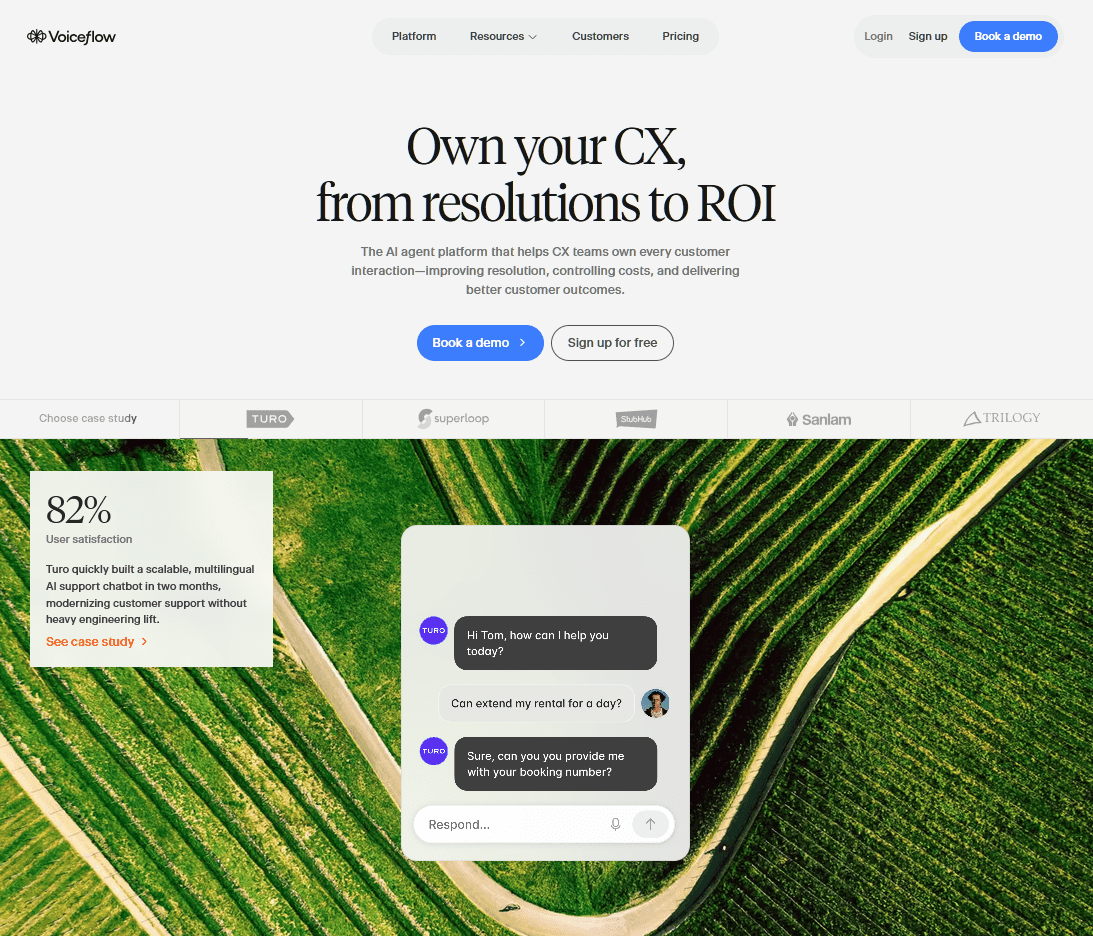
Voiceflow is a visual builder that is widely regarded as best-in-class, and the platform plays nicely with all the major LLM providers. Try Voiceflow if you want to design serious conversational experiences.
It started as a tool for building Alexa skills and evolved into a collaborative workspace for building, testing, and shipping chat and voice agents.
Key Features and What Stood Out
- Best-in-class visual builder for designing complex flows.
- All major LLMs available (GPT, Claude, and more) plus API access.
- Chat and voice sit on the same platform.
- Strong collaboration tooling with versioning, comments, and a shared canvas.
- Built-in evaluations and observability for testing agents in staging.
Limitations and What to Watch For
- Per-editor pricing can add up quickly. A five-person business team could spend over $350 per month before any overages.
- The credit system creates unpredictability, especially on voice.
- Expect a 2-to-3 month timeline for production-ready support automation.
Pricing
Voiceflow has a free Sandbox tier, Pro from $60/editor/month (with credit sub-tiers up to $120), and Team/Business at $150/editor/month, plus Enterprise custom pricing.
Voice and LLM usage consume credits on top.
5. Landbot
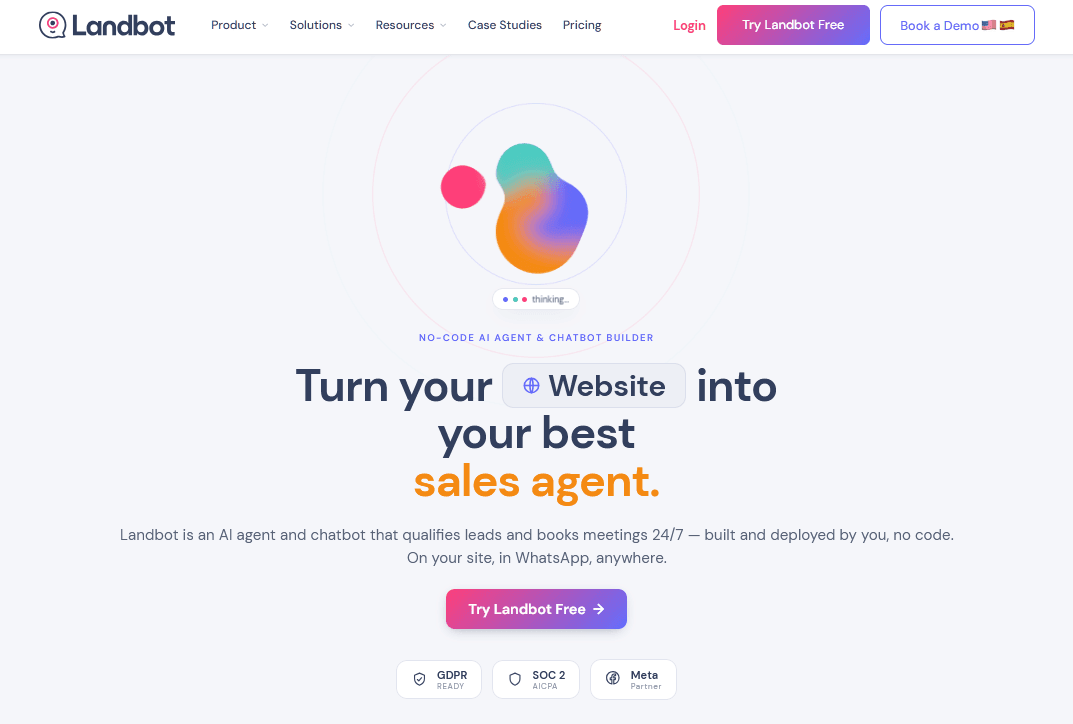
Landbot, Its drag-and-drop flow builder is one of the friendliest in the industry, and for structured, form-like conversations (lead capture, surveys, appointment routing) it's still a pleasure to use.
The company has repositioned around AI over the last couple of years.
Landbot works across websites, WhatsApp, and Facebook Messenger. Which makes it a solid pick for marketers who want branded on-brand chatbots that double as lead-gen tools.
Key Features and What Stood Out
- Genuinely outstanding no-code visual builder with variables, jumps, and conditional branches.
- Hybrid approach that blends structured flows with native AI steps.
- Multichannel: web, WhatsApp, Facebook Messenger.
- AI Copilot that builds flows from natural-language descriptions, which is faster than you'd expect.
- AI Appointment Assistant for turning leads directly into bookings.
Limitations and What to Watch For
- The dedicated WhatsApp tier increases costs significantly
- AI chats are billed separately from regular chats, on top of your plan.
- Rule-based chatbot roots. Less naturally conversational than pure-AI tools for unscripted questions.
Pricing
Landbot has a free Sandbox (100 chats/month, 1 seat) and paid tiers priced in euros:
- Starter plan at €40/month
- Pro plan at €100/month
- WhatsApp Pro plan at €200/month
- Business plan at €400/month
With 20% off annual billing.
6. ManyChat
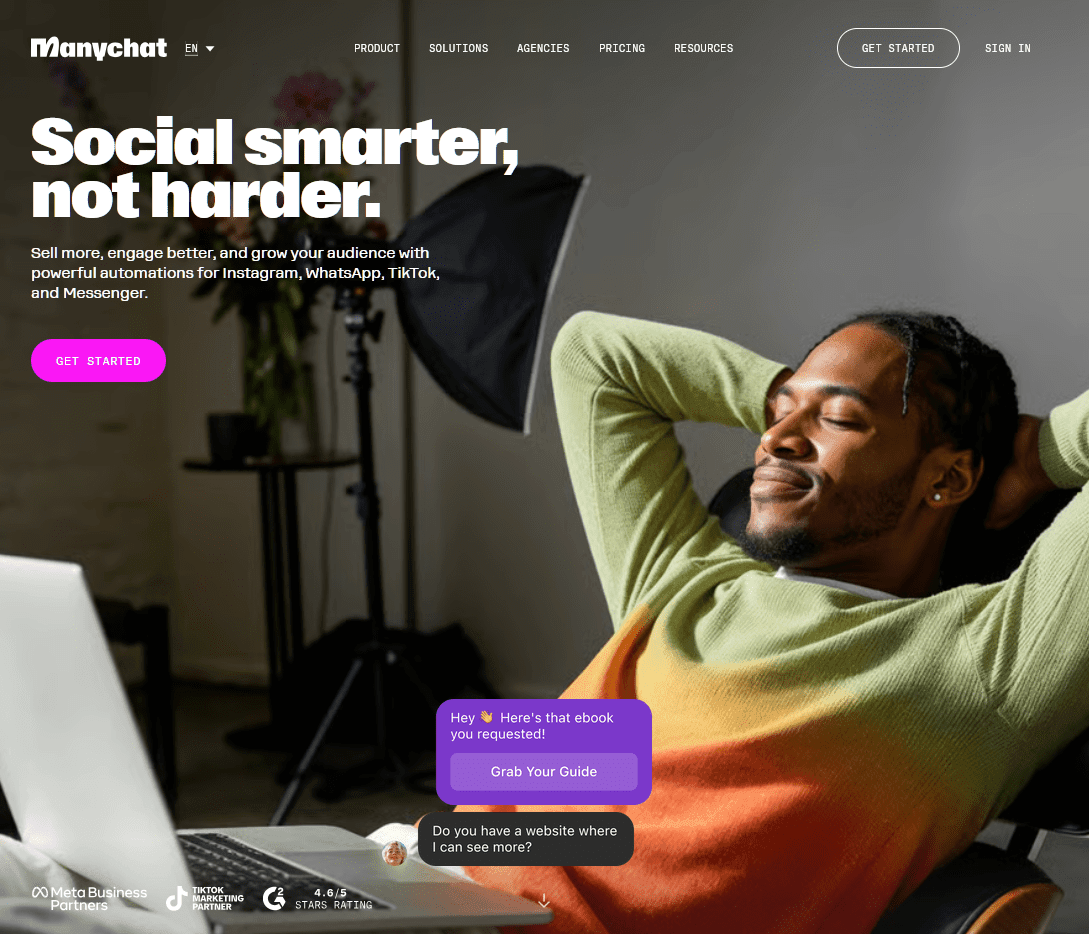
If social DMs are your channel, nothing beats ManyChat. It's the dominant platform for automating conversations on Instagram, Facebook Messenger, and WhatsApp.
ManyChat is popular among content creators and eCommerce brands that use comment-to-DM flows, lead magnets, and follow-up sequences.
This isn't a website FAQ bot like Chatbase. ManyChat is a chat marketing automation platform. Its specialty is capturing and nurturing leads inside social messaging. For that specific job, nothing else comes close. Over time, it has added AI features, including an AI Step for smarter replies.
Key Features and What Stood Out
- Best-in-class social DM automation on Instagram, Messenger, and WhatsApp, plus SMS, email, and TikTok on Pro.
- Comment-to-DM and Story-reply automation that genuinely converts.
- Contact-based pricing that improves per-contact as you scale.
- AI Step for smarter automated replies without leaving the platform.
- Huge template library covering lead gen, support, and onboarding scenarios.
Limitations and What to Watch For
- The free plan is now tiny (25 contacts) after the March 2026 cut.
- WhatsApp and SMS carry per-message Meta fees on top of your plan.
- Automatic tier scaling: cross a contact threshold and your bill jumps without a confirmation checkpoint.
Pricing
ManyChat has a free plan, but a very limited one. Pro plan starting at $17/month offering more active contacts and advanced features.
7. Rasa
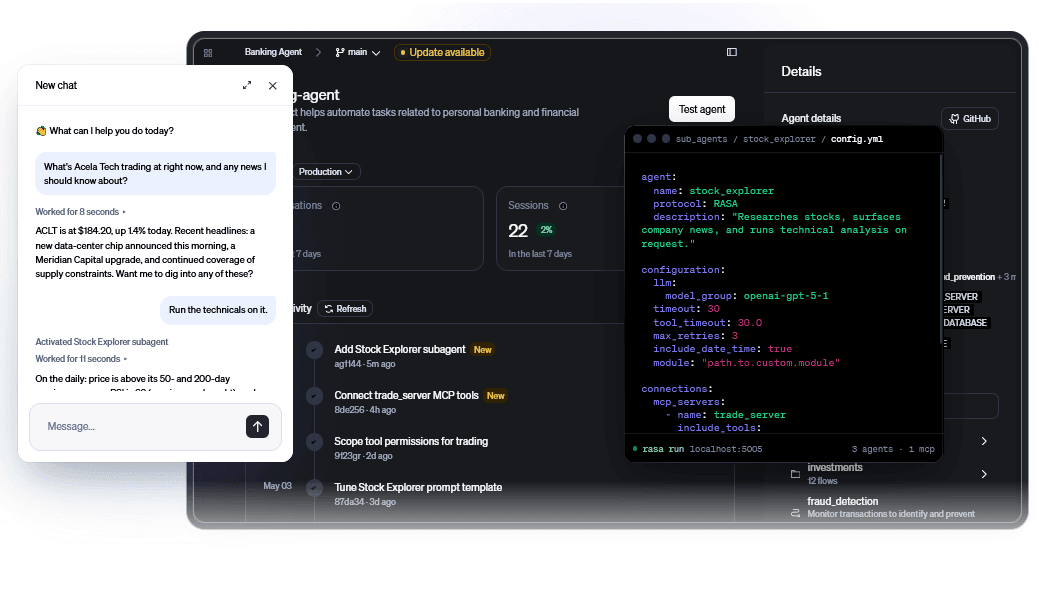
Rasa is the most complete open-source Chatbase alternative for teams that need full data ownership, a developer-first framework with a 'we need to own everything' approach.
It's an open-source framework, primarily Python and licensed under Apache 2.0, and it's self-hosted, so conversation data never has to leave your environment. This is precisely why regulated industries love it.
Banks, telcos, and healthcare teams use it precisely because it gives them full control over the model, the data, and where everything lives.
Key Features and What Stood Out
- Fully self-hosted and open-source core, for maximum data control.
- CALM architecture that blends LLM understanding with coded, deterministic actions.
- Full control of the NLU pipeline (intent classification, entity extraction, dialogue management).
- Any-language support via custom-trained NLU.
- The default choice for regulated, on-premise deployments in banking and healthcare.
Limitations and What to Watch For
- Steep engineering requirements. You need real ML and DevOps talent to run this in production.
- Long build times. Production-grade bots take genuine months to build and tune.
- Voice deployments can suffer latency issues that need careful architecture.
- The paid tier is expensive. The commercial Growth plan starts at $35,000/year.
Pricing
The Rasa Developer Edition is free and includes CALM, covering up to 1,000 external conversations per month (100 for internal employee agents).
Beyond that, there is an Enterprise plan. For full access to Rasa platform and premium support.
The control is real, and so is the bill, and not just the dollar kind. Rasa demands Python, NLP, and DevOps skills, infrastructure to run, and a team comfortable owning all of it.
It is overkill if you want a simple Chatbase alternative.
8. CustomGPT
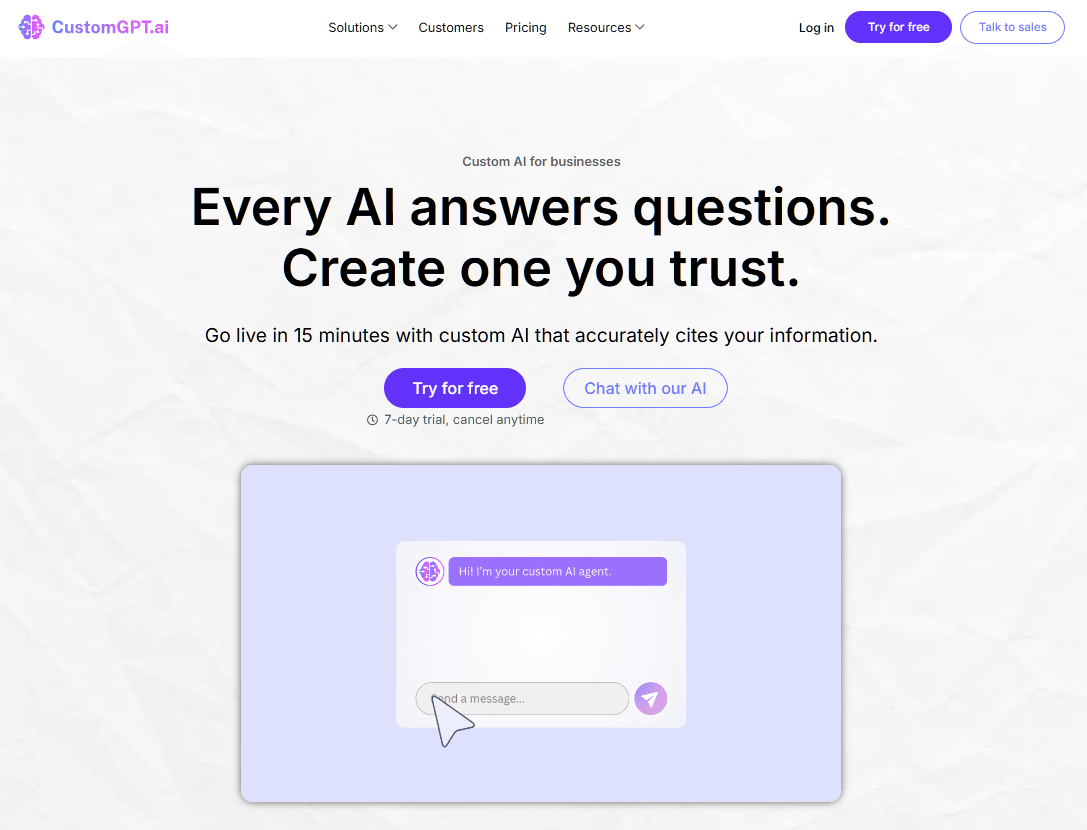
CustomGPT is a no-code platform for building private AI agents that are trained using your business's content. It prioritizes anti-hallucination technology and data security, and promises that your data will never be used to train the underlying models.
CustomGPT's customers include MIT and Bernalillo County, and the platform targets knowledge-intensive, regulated industries such as legal services, education, and finance.
You connect your data (it supports a very wide range of document formats), customize the agent, and deploy via live chat, website embed, or API. Citations are included in the responses so curious users can trust the information provided by the bot.
Key Features and What Stood Out
- Anti-hallucination focus with citations on responses, so users can verify answers.
- Very broad document format support for messy, diverse knowledge bases.
- Strong security posture. Data not used for training, SOC 2 and HIPAA at higher tiers.
- Up to 10 agents on standard accounts, which is generous for a knowledge-heavy business.
- Multiple deployment options: live chat, website embed, and API.
Limitations and What to Watch For
- The $99-to-$499 jump (5x) leaves mid-size buyers in an awkward pricing gap.
- Key features gated behind Premium (white-label, PII removal, auto-sync, API).
- Query limits on lower tiers. The Standard plan caps monthly queries.
Pricing
The CustomGPT Standard plan starts at $99 per month. The Premium plan starts at $499 per month. The Enterprise plan has custom pricing, which is commonly cited as being between $2,000 and $6,000 per month.
All plans include a 7-day free trial and annual discounts on the lower tiers.
Frequently Asked Questions about Chatbase Alternatives
Is there a free alternative to Chatbase?
Yes, there are several, and not all of them are trials. HelpJet has a free plan that never expires (one bot and 100 interactions per month). The difference lies in where the ceiling sits. HelpJet offers the friendliest free plan for small websites that want AI answers without a per-message counter.
What's the best open-source Chatbase alternative?
For a modern, LLM-native agent with a visual builder, it's Botpress (V12 is the self-hostable edition). For maximum control in regulated, on-premise environments, it's Rasa.
Which alternative offers unlimited messages?
Be skeptical of "unlimited," because it usually means "unlimited until the AI credits run out." The best way to truly get unlimited messages is to use self-hosted open-source tools. With these, you pay for your own infrastructure and model API calls rather than paying per message.
Summary: Picking Your Chatbase Alternative
Many people search for Chatbase alternatives, but that doesn't mean Chatbase is bad. Rather, it's because Chatbase is priced and built for one specific job: fast, simple FAQ bots. Most businesses eventually need something more predictable, customizable, and owned.
For the average website owner, especially on WordPress, HelpJet is the pick.
It removes the two things that make Chatbase frustrating (credit math and setup complexity) while keeping the one thing that makes Chatbase useful (train on your content, answer instantly).
Developers get better answers from Botpress and Rasa.
Enterprise support lives on Intercom Fin.
👋 See you in the next guide.
Keep reading
- 10 Best DocsBot Alternatives and Competitors (2026 Guide)
- 8 Best Free AI Chatbots for Websites in 2026Compare 8 free AI chatbots for websites by free plan limits, AI features, setup and upgrade cost, and find the right free chatbot for your site.
- 8 Best SaaS Chatbots for 2026: Free, AI and Open-Source Options ComparedCompare 8 best SaaS chatbots for 2026, including free, AI, and open-source options. See pricing, features, limits, and support use cases today.
Put this into practice
HelpJet learns your docs and takes the repetitive questions off your plate. Set up in about 5 minutes.
Try HelpJet freeFree plan, no credit card. Hard stop at the limit, never a surprise charge.
Share this article