How To Deal with Angry Customers in 2026 (Scripts and Real Examples)
On this page

THIRD TIME ASKING. WHERE IS MY REFUND???
If you've spent more than a week in a support inbox, you've seen an email like this one. You read it twice, your shoulders tense up a little, and then you have to decide what to write back.
That moment is what this guide is about.
This guide explains why customers become frustrated, how to handle difficult customer interactions step by step, and which phrases help de-escalate tense conversations instead of making them worse.
Why Customers Get Angry

Customer anger often starts with a problem, but poor complaint handling can make the situation worse.
A late package, failed payment, or billing error may frustrate a customer, while delayed responses, unclear updates, and repeated explanations can turn that frustration into a serious customer service complaint.
You often can't control the original problem, but you have a lot of control over how it gets handled.
What Angry Customers Say vs. What's Going on Underneath
When responding to upset customers, look beyond their angry words to understand the problem they're trying to solve.
Once you understand what usually lies behind each one, crafting a response becomes much easier.
What the customer says | What's usually underneath | What helps most |
|---|---|---|
I've been waiting a WEEK. | They feel ignored | A fast, specific reply with a time attached |
This is the third time I'm explaining this. | Your team isn't sharing context | Reading the full history before you reply |
Nobody told me about this charge. | A broken promise or unclear terms | Owning the confusion, then explaining |
What kind of policy is that? | A rule with no reason attached | The reason, plus the closest alternative |
Let me speak to your manager. | They feel powerless or unheard | Real choices, and proof you listened |
I'm never buying from you again. | Disappointment, often after years of loyalty | Acknowledging the history they have with you |
However, a few causes don't show up in the wording as clearly:
- How much effort the fix takes. Long phone menus, broken contact forms, and being bounced between channels all pile up.
- Stress from somewhere else. The person may be on a deadline or dealing with something at home, and your late refund is the thing that tipped them over.
- Old scars from a past company (or from yours, a year ago). These customers show up braced for a fight, and a calm, quick first reply does a surprising amount of work with them.
- A clash over values. A refund won't fix these conversations, and we'll come back to them in the abuse section.
Pro tip: For one month, tag every angry ticket with its root cause from the table above. Most teams find that two or three causes account for the bulk of their heated tickets, and those can usually be fixed with a process change rather than better wording.
Anger Is Feedback (Even When It's Delivered Badly)
"Your most unhappy customers are your greatest source of learning."
Bill Gates, Business @ the Speed of Thought (1999)
Gates wrote that more than 25 years ago, and support teams still relearn it the hard way.
A customer shouting about a week-long wait is telling you your response times are off, and one raging about a surprise fee is telling you something about your checkout page.
So the individual conversation needs calming down, and the pattern behind it belongs on the agenda for your next team meeting.
Explore: 14 Proven Strategies to Improve Customer Service covers the bigger fixes that could cut down on angry tickets in the first place.
Tools That Create Fewer Angry Customers
Heroic Inbox: Shared Inbox Software
Heroic Inbox turns your WordPress dashboard into a shared inbox and help desk. Your team works support@, billing@, and any other addresses from one screen, and each email becomes a conversation with an owner, a history, and private notes.
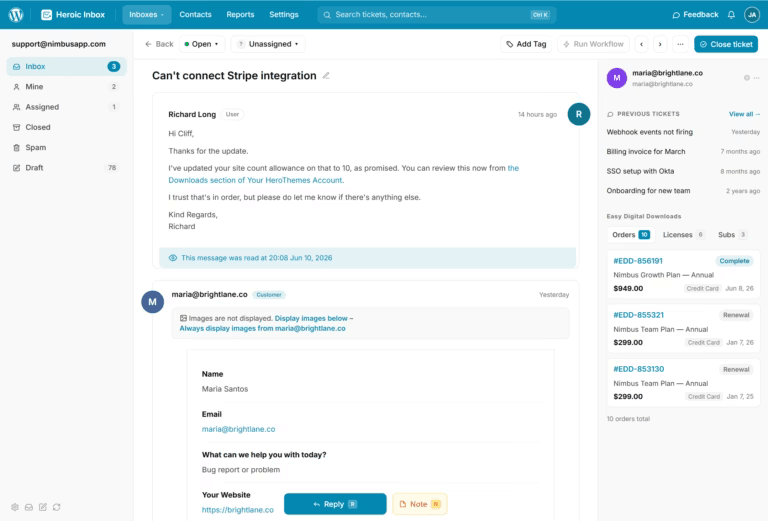
Here's how it maps to the complaints in that table at the top of this guide:
- "Nobody answered me for days" usually means an email sat in a shared mailbox while everyone assumed someone else had it. Assignments put one name on every conversation.
- "Your team told me two different things" happens when two agents reply at once. Collision detection shows when a teammate is viewing or typing in the same conversation.
- "This is the third time I'm explaining this" gets easier to avoid because the customer sidebar shows past conversations, and on the Pro plan it also pulls in WooCommerce and Easy Digital Downloads order details.
- Saved replies give agents a calm starting point for common situations.
- Internal notes let an agent brief a manager inside the thread before escalating.
- Workflow automation helps with prioritizing tickets, setting follow ups or out of office responses.
- AI reply assistant to draft reply based on ticket context.
HelpJet: For the Questions Customers Shouldn't Have to Wait On
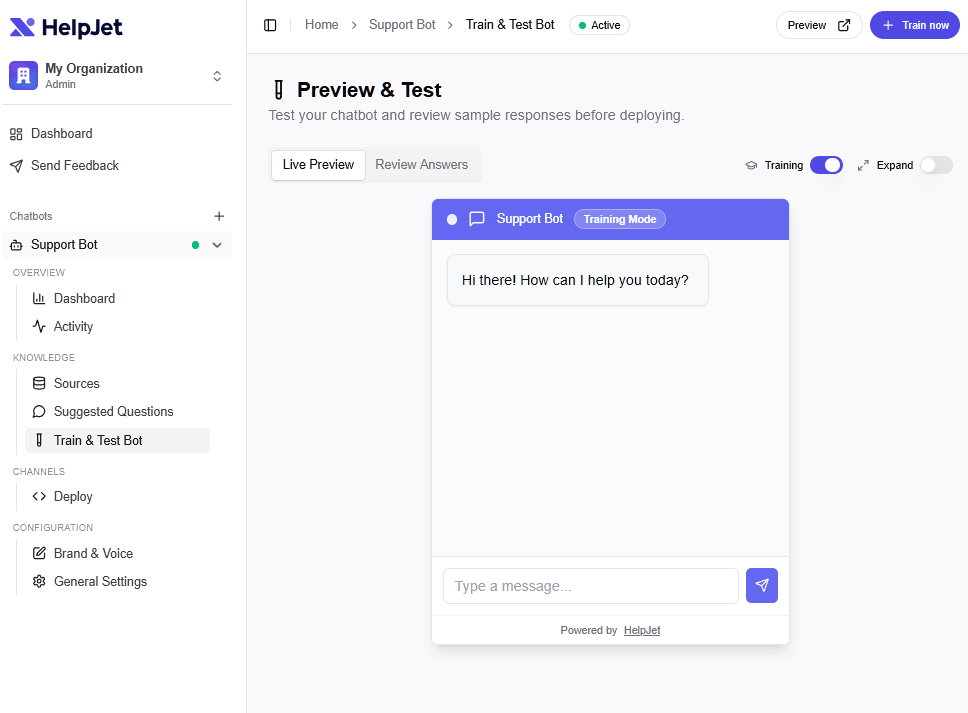
HelpJet is an AI support chatbot. It learns from your website pages, help articles, and PDFs, then answers customer questions through a chat widget you can embed on WordPress, Shopify, Wix, and other platforms.
Its job in this guide is narrow. HelpJet answers repetitive questions like "where's my order" and "how do I reset my password" right away, so those customers never reach the point of being angry about waiting.
Three things make it a reasonable fit for anger prevention:
- When a question needs a human, it says so and points the customer to your contact form, email, or phone number, instead of trapping them in a loop
- It answers from content you've already written, so better help articles mean better bot answers
- Conversation logs show what customers asked and where the bot struggled
How to Deal with an Angry Customer: 8 Steps
These customer service de-escalation techniques work across email, live chat, phone calls, and in-person conversations.
Follow the steps in order to understand the complaint, lower tension, and work toward a resolution without making the customer more frustrated.
Step 1: Calm Yourself Down First

Before you type a word, take one slow breath. On the phone, count to five before you respond to the first outburst.
That sounds like fluffy advice until you see the research.
In a March 2024 review of 154 studies published in Clinical Psychology Review, Ohio State researchers Sophie Kjærvik and Brad Bushman found that activities that lower your arousal (slow breathing, short breaks, even yoga) reliably reduced anger, while "blowing off steam" did little to help.
It also helps to remember who the anger is aimed at. The customer is angry at a situation, and you happen to be the person standing closest to it.
Step 2: Let Customers Finish
Let the customer get the whole story out before you say anything more than "I'm listening" or "go on." Jumping in early, even with the right solution, tells them you care more about closing the ticket than hearing them out.
On email, read the full message twice.
Angry emails have a habit of hiding the real request.
Step 3: Name What Customers Feeling
In a 2007 brain-imaging study, UCLA psychologist Matthew Lieberman and his team found that putting a feeling into words (researchers call it "affect labeling") turned down activity in the amygdala, the part of the brain that reacts to threats.
Former FBI hostage negotiator Chris Voss teaches the same idea under the name tactical empathy.
In a customer support conversation, it sounds something like this:
- It sounds like you've been chasing this for days.
- It seems like that charge came out of nowhere.
- I can hear how frustrating it is to explain this again.
- If I'd been charged twice, I'd be annoyed too.
You'll notice "I understand how you feel" isn't on that list.
Customers have heard it so many times that plenty of them read it as "I'm working from a script."
Step 4: Apologize for the Right Thing
A good apology names the problem and owns your part in it. "I'm sorry you feel that way" does the opposite, because it apologizes for the customer's reaction and quietly blames them for being upset.
Disney trains its cast members on the idea that a service failure may not be their fault, but it's still their problem to solve.
That's a useful frame when the real cause is a courier or a payment processor you have no control over.
We call this a blameless apology: you take responsibility for fixing things without pointing at anyone.
Here are some examples of how to apologize to customers:
Weak apology | Better apology |
|---|---|
I'm sorry, but the warehouse messed up again. | I'm sorry your order arrived late. That's not what we promised, and I'm going to sort it out. |
I'm sorry if our shipping policy confused you. | I'm sorry the delivery date wasn't clearer at checkout. |
I'm sorry you feel that way. | I'm sorry this happened, and I'm sorry it's taken this long to fix. |
Step 5: Confirm the Actual Problem
Restate the problem in one sentence and check that you've got it right.
For example, "So the charge went through twice, and you need one of them refunded before your statement closes on Friday. Is that right?"
It's better to understand it clearly than to speculate.
It also catches the surprisingly common case where the customer wants something different from what you assumed (maybe they don't want a refund at all, they just want the order shipped).
If you need more details, simply ask the customer.
Step 6: Offer a Fix with a Real Deadline
When resolving a complaint from a frustrated customer, offer a clear solution and explain exactly what happens next.
Tell the customer what you'll do, when they'll receive an update, and when they can expect the issue to be resolved. A realistic deadline gives them something concrete to rely on instead of another vague promise.
Compare "We'll look into it" with "I've issued the refund, and it should show on your statement within five business days."
The first response will likely result in an angry email on Thursday, while the second response will usually end the conversation.
When you can, offer two options instead of one: "I can send a replacement today with express shipping, or refund you in full. Which would you prefer?"
Offering a choice gives the customer some of their control back after things went wrong.
Step 7: Follow Through, Then Check In
Always do what you promised by the time you promised it. Then send a one-line check-in once the fix should have landed.
Something like "Just making sure the refund showed up on your end."
It takes 30 seconds, and customers remember it far longer than the refund itself.
It also helps catch the cases where the fix didn't work before the customer has to write in again.
Step 8: Log the Root Cause
Before you close the ticket, leave an internal note about what caused the problem, tag it, and give a heads-up to whoever owns that part of the business.
Disney calls this step "Diagnose," the D in its HEARD framework.
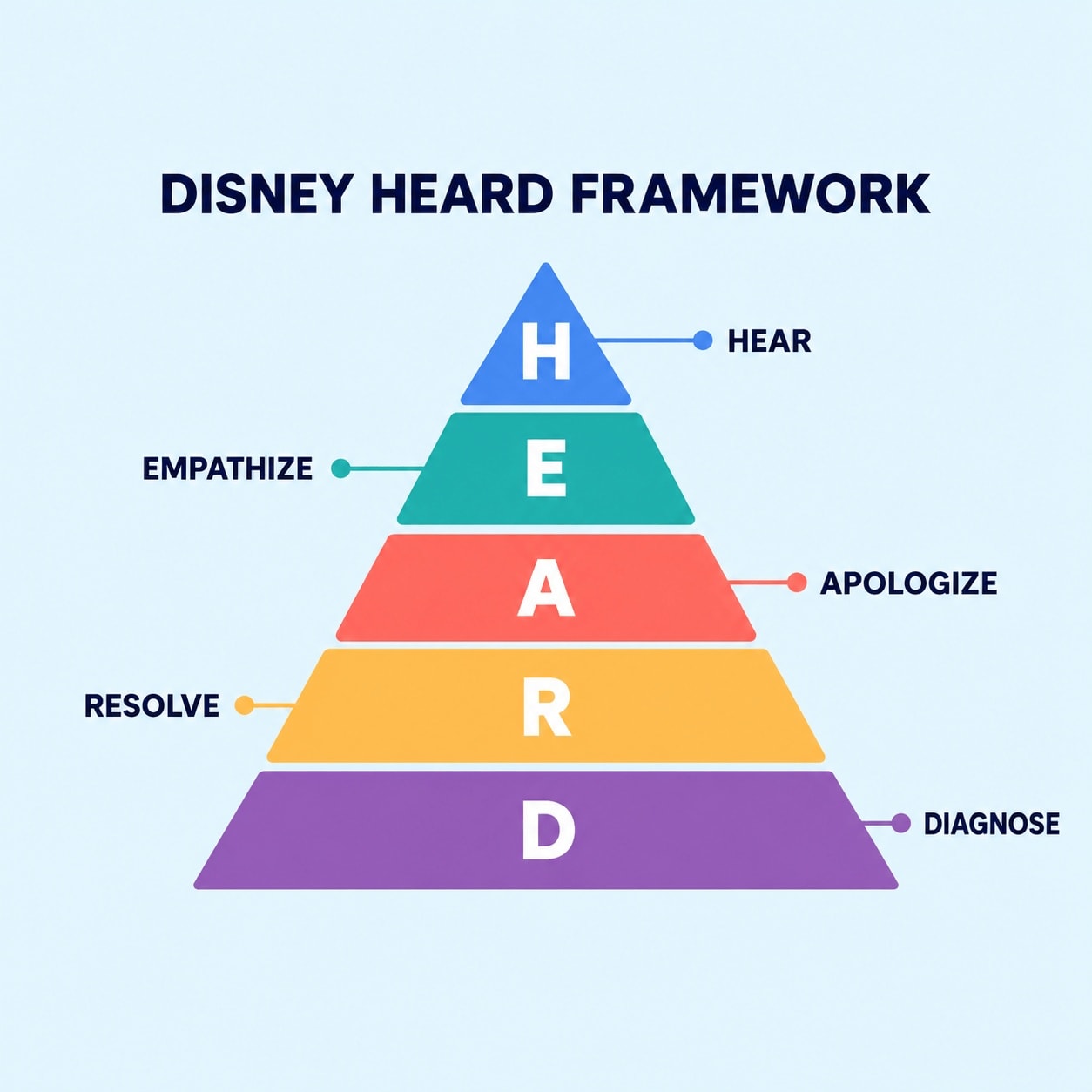
Skip it for a few weeks and you'll find yourself answering the same angry ticket over and over.
Putting It Together: One Angry Email, Two Replies
Here's how the above steps look on a typical complaint.
Customer email: I ordered a coffee grinder on the 3rd and was told it would arrive by the 8th. It's the 14th. I've emailed twice and got the same useless copy-paste reply both times. If I don't hear something real today I'm disputing the charge.
Reply A (the one that makes things worse):
Hi, thank you for reaching out! We apologize for any inconvenience. Shipping times can vary due to carrier delays, so please allow 3-5 more business days. If you have any further questions, don't hesitate to contact us!
Reply B (the one that calms things down):
Hi Sam, you're right to be frustrated. You were promised the 8th, it's now the 14th, and the two replies you got didn't help. I'm sorry about both.
I checked with the carrier, and your package has been stuck at their Columbus hub since the 10th. I shipped a replacement by express this morning (tracking number below), so you should have it by Thursday. If the original turns up first, keep it or refuse it, whichever is easier. There's no charge either way.
I'll check in Thursday afternoon to make sure it arrived.
Reply A is polite enough, but it ignores everything Sam wrote: the dates, the two earlier emails, and the threat of a chargeback. On the other hand, Reply B names the problem, owns the bad replies, gives a specific fix, and sets a follow-up in about 100 words.
What to Say to an Angry Customer (and What to Avoid)
Choosing the right words is an important customer service skill, especially when dealing with frustrated customers.
The same response can either calm a customer down or upset them further, depending on how it's phrased.
Instead of this | Try this | Why it works better |
|---|---|---|
Calm down. | Let's get this sorted out together. | It invites teamwork instead of judging their reaction |
I understand how you feel. | It sounds like you've been chasing this for days. | A specific label proves you were listening |
That's our policy. | Here's why we have that rule, and here's what I can do. | A reason makes a limit feel fair |
I'm sorry you feel that way. | I'm sorry this happened. | It apologizes for the event instead of the reaction |
You should have read the terms. | I can see how that wasn't clear. Let me walk you through it. | It takes the blame off the customer without giving away the policy |
There's nothing I can do. | Here's what I can do right now. | The customer always leaves with a next step |
We'll look into it. | I'll update you by 3 p.m. tomorrow. | A deadline replaces worry with a plan |
Unfortunately... | Lead with the answer or the good news | Opening with bad news sets up more anger |
As I said before... | Let me put that another way. | It drops the hint that they weren't paying attention |
Why "Calm Down" Never Works
Has anyone ever calmed down because you told them to?
The phrase tells the customer their reaction is wrong, which hands them a second thing to be angry about.
"Relax," "there's no need to shout," and "you're overreacting" all land the same way.
If the customer's language itself is the problem, deal with it directly using the warning script in the abuse section below.
4 Customer Service Scripts for Difficult Situations
Treat these as starting points and rewrite them in your own voice. The bracketed bits are where the personal details go.
The Late or Missing Order
Hi [Name],
you're right to be frustrated. Your order should have arrived on [date], and it hasn't.
I've checked with the carrier and [specific status], so I've [sent a replacement with express shipping / issued a full refund], and you'll get tracking by [time].
I'll check in on [day] to make sure it's arrived.
The Double Charge
Hi [Name],
I can see the duplicate charge of [$amount] on [date], and I'm sorry for the scare. I've refunded it just now.
Banks usually take three to five business days to show it on your statement, so if it isn't there by [date], reply here and I'll chase it personally.
The Repeat Contact ("I've Explained This Three Times")
Hi [Name],
I'm sorry you've had to explain this more than once, and that's on us.
I've read your full history with us, so you won't need to repeat anything.
Here's where things stand: [summary].
I'm keeping this ticket myself until it's resolved.
The Request You Can't Grant
Hi [Name],
I wish I had a better answer for you.
We can't [refund after 90 days / extend the license] because [honest reason].
What I can do is [alternative 1] or [alternative 2].
Would either of those help?
If you want a bigger library to work from, this guide on 25+ canned email templates for customer support include replies for complaints, refunds, and frustrated customers.
What To Do When an Angry Customer Is Wrong or Abusive
Some angry customers are in the wrong, and a few cross the line from anger to abuse.
Handling difficult customers doesn't mean accepting abuse. Your team needs clear guidelines to distinguish between frustrated customers and those who use personal insults, threats, or harassment.
Is the Customer Always Right?
No. "The customer is always right" started as a retail slogan in the early 1900s, meant to reassure shoppers, and it was never meant to run a support team.
Taken literally, it teaches your loudest customers that shouting works.
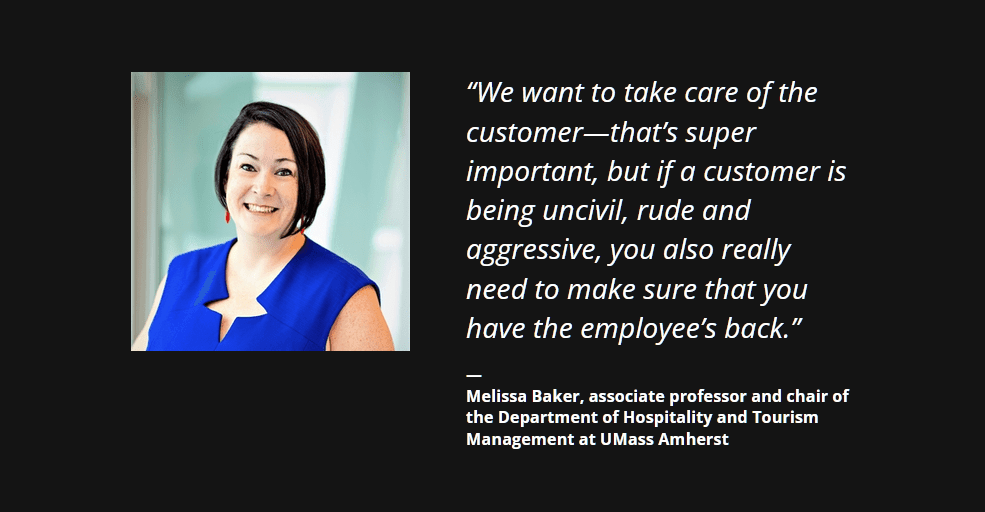
Research from the University of Massachusetts Amherst backs this up. A study led by Melissa Baker found that rude customers, and company policies that encourage them, hurt employees' mental health and their ability to serve everyone else.
The same study found that clear policies against uncivil behavior helped the most vulnerable employees do better work.
A better motto for the break room wall: the customer is always heard, but not always right. You can respect the person, take the complaint seriously, and still say no.
How To Say No Without Losing the Customer
Turning down an angry customer is a skill, and it gets easier with a few habits:
- Give the reason behind the policy. "We can't refund digital downloads once they've been used, because there's no way to return them" works much better than a flat no.
- Agree with the feeling, even when you can't agree with the demand. "I can see why you'd want that, and I'd probably want it too" costs nothing.
- Find the smaller yes. It might be a credit, a workaround, a discount on the next order, or faster shipping, and there's almost always something.
- Treat every customer the same. If the one who shouts gets more than the one who asks politely, you've built a system that rewards shouting.
- Allow one escalation, not an endless climb. A manager reviewing a decision is fair, but letting a customer go up the org chart until someone caves teaches everyone that your policies are optional.
How To End an Abusive Conversation
Upset customers vent about the situation. Abusive customers go after your team personally, with insults, slurs, threats, or attacks that continue no matter what you say.
That's where de-escalation stops and boundaries start. Give agents a simple three-step script so they never have to make it up on the spot.
- Name the behavior once. "I want to help you fix this, and I can't do that while you're using that language."
- Explain what happens next. "If it continues, I'll need to end this call, and you can reach us again by email."
- Follow through calmly. "I'm ending the call now. Your ticket number is 4821, and we'll pick it up by email."
The same three steps work in writing on email and chat. Save the conversation, add an internal note, and flag the account for a manager.
Note: Threats of violence, doxxing, or harassment of a named employee aren't a customer service issue anymore. Escalate them to a manager right away, document everything, and involve law enforcement where warranted.
When To Fire a Customer
Sometimes, the kindest thing for everyone is to part ways.
Southwest Airlines co-founder Herb Kelleher offers a well-known example. One frequent flyer, nicknamed the “Pen Pal” by staff, wrote to complain after nearly every flight.
According to Kevin and Jackie Freiberg's book Nuts!, when one of her letters ended up on Kelleher's desk, he replied: "Dear Mrs. Crabapple, We will miss you. Love, Herb."
His team got the message that Southwest valued customers, but not at the expense of its people.
It may be time to part ways with a customer who:
- keeps abusing staff after a clear warning
- costs more in support hours every month than their plan brings in
- wants a product you don’t offer, and no amount of support will change that
- abuses your policies through repeated refund claims or chargeback fraud
End the relationship politely and in writing. Refund any unused time, recommend an alternative if you can honestly stand behind it, and close the account without a lengthy explanation.
How To Protect Your Team from Angry-Customer Burnout
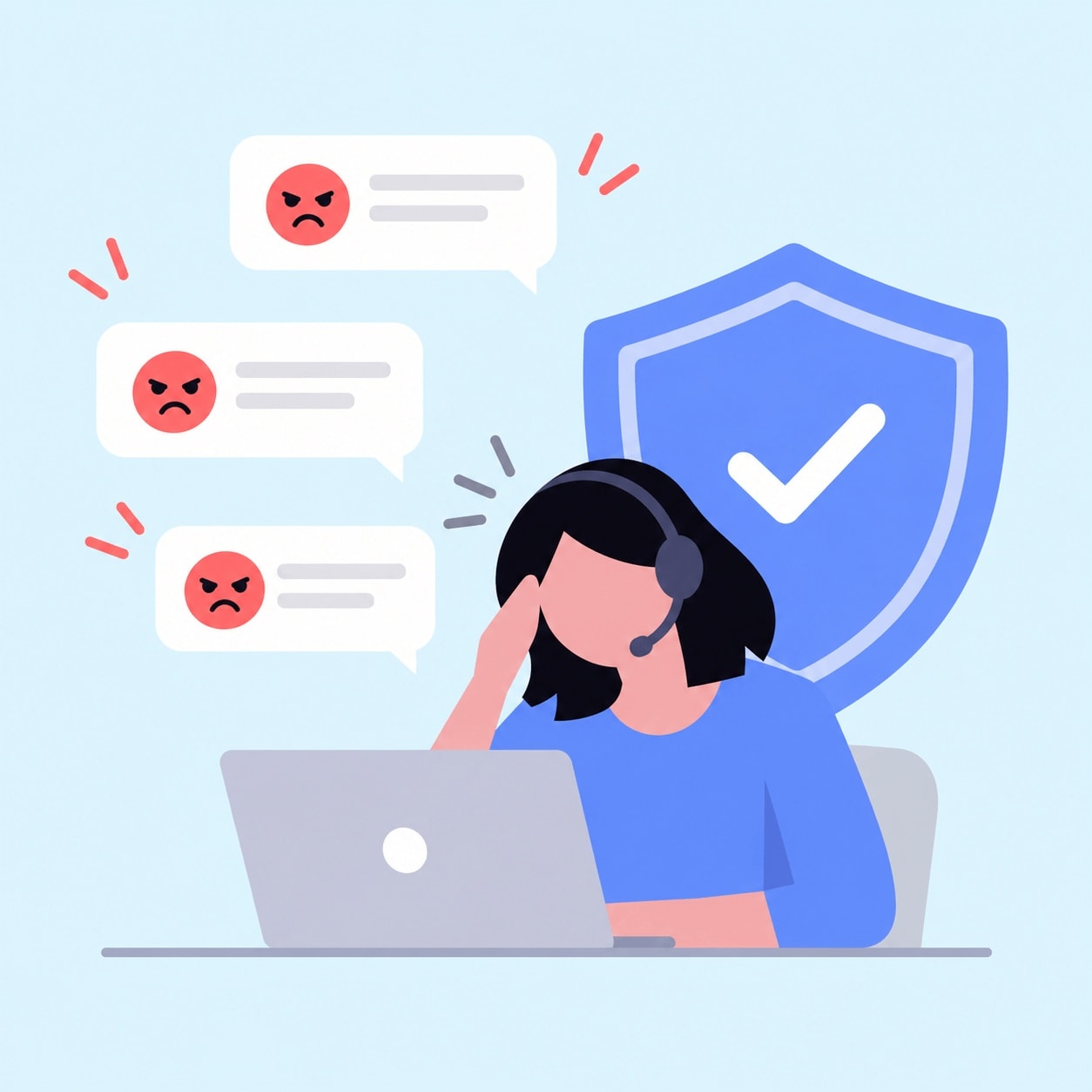
If you manage a customer support team, helping agents handle frustrated customers without burning out should be a priority.
A full day of dealing with angry customers can wear people down, and leaders often underestimate just how much.
What Agents Need from Their Manager
Agents will put up with more abuse than they should if they aren't sure you'll back them.
These are the things that make the support real:
- A written abuse policy that defines what counts as abusive, what agents are allowed to do about it, and says plainly that no one gets penalized for ending an abusive call
- Public backing and private coaching, so mistakes get fixed in a one-on-one and never in front of the customer
- A five-minute reset after a hard call, which is the kind of short, calming break the anger research supports (and far cheaper than a sick day or a resignation)
- Rotation on the toughest queues, so the same person isn't on cancellations or escalations every day
- A quick team debrief on the worst ticket of the week, which turns a bad day into something everyone learns from
What Agents Can Do for Themselves
If you're the one taking the calls, a few habits help more than being told not to take it personally:
- Silently name your own reaction ("I'm getting defensive"). It's the same affect-labeling trick you use on customers, pointed inward.
- Keep one go-to opening line for angry customers, so your nervous system doesn't have to improvise under pressure.
- Write the internal note right after the conversation. Getting the details into the ticket makes it easier to let the conversation go.
- Ask for an escalation early when someone becomes abusive. Handing it off is a judgment call, and a good one.
Final Thoughts: How To Deal with Angry Customers
Dealing with angry customers comes down to doing things in the right order.
- Settle the emotion before you offer a solution
- Apologize for the specific thing that went wrong
- Give a deadline you can keep
- Check back once the fix has landed.
Patience matters, but it has limits.
Customers deserve to be heard every time, and your team deserves a clear point where abuse ends the conversation.
Keep reading
- 10 Best DocsBot Alternatives and Competitors (2026 Guide)
- 8 Best Free AI Chatbots for Websites in 2026Compare 8 free AI chatbots for websites by free plan limits, AI features, setup and upgrade cost, and find the right free chatbot for your site.
- 8 Best SaaS Chatbots for 2026: Free, AI and Open-Source Options ComparedCompare 8 best SaaS chatbots for 2026, including free, AI, and open-source options. See pricing, features, limits, and support use cases today.
Put this into practice
HelpJet learns your docs and takes the repetitive questions off your plate. Set up in about 5 minutes.
Try HelpJet freeFree plan, no credit card. Hard stop at the limit, never a surprise charge.
Share this article